
Introduction
Search Engine Optimization (SEO) is one of the most important digital marketing strategies for improving website visibility and attracting organic traffic. While many people focus on content creation and keyword optimization, technical SEO plays an equally important role in helping search engines understand, crawl, and index a website effectively.
Alongside technical SEO, metrics such as Domain Authority (DA) and Page Authority (PA) are often used to evaluate a website’s ability to rank in search engine results. Understanding how technical SEO, DA, and PA work together can help businesses build a stronger online presence and achieve better rankings.
In this article, we’ll explore technical SEO in detail, explain the importance of DA and PA, and discuss how these factors contribute to SEO success.
What Is Technical SEO?
Technical SEO refers to the process of optimizing a website’s technical elements to improve its crawlability, indexability, performance, and user experience. It focuses on the backend structure of a website rather than content optimization.
The goal of technical SEO is to ensure that search engines like Google can easily access, understand, and rank your website.
Key Objectives of Technical SEO
- Improve website crawling and indexing
- Enhance website speed and performance
- Ensure mobile-friendliness
- Fix technical errors
- Improve website security
- Create a better user experience
- Help search engines understand website structure
Why Technical SEO Is Important
Even if you create high-quality content, your website may struggle to rank if search engines cannot properly crawl or index your pages.
Technical SEO helps:
- Increase search visibility
- Improve website performance
- Enhance user experience
- Reduce bounce rates
- Support content and link-building efforts
- Improve ranking potential
A technically optimized website creates a strong foundation for all other SEO activities.
Key Components of Technical SEO
1. Website Crawling and Indexing
Search engines use bots (also called crawlers or spiders) to discover and analyze web pages.
To ensure proper crawling:
- Create an XML sitemap
- Optimize robots.txt files
- Remove crawl errors
- Fix broken links
- Avoid duplicate content
Proper indexing ensures that your pages appear in search engine results.
2. Website Speed Optimization
Page speed is a confirmed ranking factor and directly impacts user experience.
Ways to improve speed:
- Compress images
- Use browser caching
- Minify CSS and JavaScript
- Enable GZIP compression
- Use a Content Delivery Network (CDN)
- Reduce server response times
Fast-loading websites generally perform better in search rankings.
3. Mobile-Friendly Design
Google uses mobile-first indexing, meaning it primarily evaluates the mobile version of a website.
Best practices include:
- Responsive design
- Mobile-friendly navigation
- Fast mobile loading times
- Readable font sizes
- Proper spacing between elements
A poor mobile experience can negatively affect rankings.
4. HTTPS Security
Google prefers secure websites.
Installing an SSL certificate:
- Encrypts data
- Protects users
- Builds trust
- Improves SEO performance
Websites should use HTTPS instead of HTTP.
5. Structured Data (Schema Markup)
Schema markup helps search engines understand website content more effectively.
Benefits include:
- Rich snippets
- Enhanced search appearance
- Improved click-through rates
- Better content categorization
Common schema types:
- Articles
- FAQs
- Reviews
- Products
- Local businesses
6. URL Structure Optimization
SEO-friendly URLs should be:
- Short
- Descriptive
- Keyword-rich
- Easy to read
Example:
Good:
www.example.com/technical-seo-guide
Bad:
www.example.com/page?id=12345
7. Internal Linking
Internal links help search engines understand website hierarchy.
Benefits:
- Better crawlability
- Improved user navigation
- Distribution of link equity
- Increased page authority
A strong internal linking strategy supports overall SEO performance.
What Is Domain Authority (DA)?
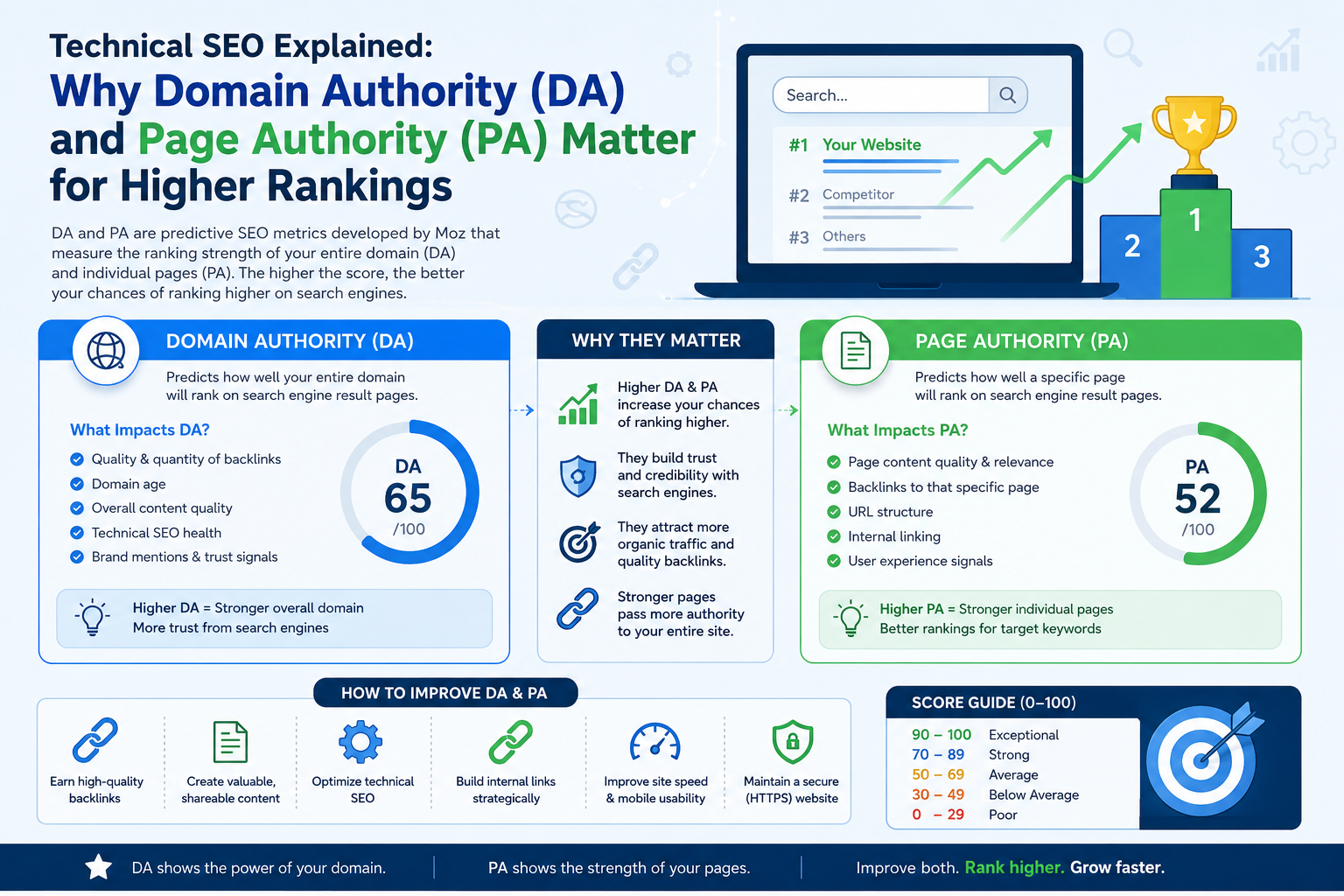
Domain Authority (DA) is a metric developed by Moz that predicts how likely a website is to rank in search engine results.
DA scores range from:
- 1 to 100
Higher scores generally indicate stronger ranking potential.
Examples
- DA 10–20: New websites
- DA 20–40: Growing websites
- DA 40–60: Established websites
- DA 60–80: Highly authoritative websites
- DA 80+: Major brands and industry leaders
It’s important to note that DA is not a Google ranking factor. It is a third-party metric used to estimate website authority.
Factors That Influence Domain Authority
Quality Backlinks
High-quality backlinks from authoritative websites significantly improve DA.
Linking Root Domains
The number of unique websites linking to your domain affects authority.
Content Quality
Valuable and informative content attracts natural backlinks.
Website Trustworthiness
Secure, well-maintained websites often earn more authority.
Technical SEO
A technically sound website supports better crawling and indexing, indirectly helping authority growth.
What Is Page Authority (PA)?
Page Authority (PA) is another Moz metric that predicts the ranking ability of an individual page rather than an entire domain.
PA also uses a scale of:
- 1 to 100
While DA evaluates the whole website, PA focuses on specific URLs.
Difference Between DA and PA
| Factor | Domain Authority (DA) | Page Authority (PA) |
|---|---|---|
| Scope | Entire website | Individual page |
| Measures | Overall domain strength | Specific page strength |
| Scale | 1-100 | 1-100 |
| Influenced By | Domain-wide backlinks | Page-specific backlinks |
| SEO Purpose | Website authority evaluation | Page ranking potential |
Both metrics are useful when analyzing SEO performance. You can checkout your website’s domain authority and page authority by DA PA Checker