
In an era where digital surveillance, data breaches, and the commodification of personal information are commonplace, the need for private communication tools has never been more critical. Enter Tutanota, now rebranded simply as Tuta. Based in Germany, Tuta is not merely an email service provider; it is a comprehensive, open-source security platform dedicated to the principle that privacy is a fundamental human right. It provides end-to-end encrypted email, calendar, and contacts, creating a “zero-knowledge” environment where only the user can access their data.
This article explores what makes Tuta unique, its fundamental architectural choices, its commitment to open source, and how it is paving the way for the future of encryption.
1. Introduction: What is Tuta?
Tuta is a secure email and communication service developed by Tutao GmbH, headquartered in Hanover, Germany. Since its launch in 2011, it has grown to serve over 10 million users globally. Its primary function is to offer a “privacy-first” alternative to mainstream email providers like Gmail or Outlook, which scan user data for advertising purposes and are vulnerable to government surveillance.
Tuta’s foundational architecture is based on automatic, ubiquitous end-to-end encryption (E2EE). From the user’s perspective, Tuta behaves like any modern email client—it has a clean interface, mobile apps, and smart features—but under the hood, it operates with a radically different approach to security.
The 2023 Rebranding: Tutanota becomes Tuta
On November 7, 2023, the company announced its rebranding to Tuta. The name change represents more than simplification; it reflects the platform’s expansion. While it started as an email service, Tuta now offers a complete suite of encrypted productivity tools, including a secure calendar and contacts manager, with an encrypted drive (Tuta Drive) under development. Tuta remains dedicated to the same principles, hosted on the same secure, green-energy-powered servers in Germany.
2. Core Features of the Tuta Platform
Tuta distinguishes itself from mainstream and other secure email providers through its extensive default encryption. Most secure emails only encrypt the message body. Tuta goes much further.
A. End-to-End Encrypted (E2EE) Email
In Tuta, encryption is not an option; it is the fundamental standard.
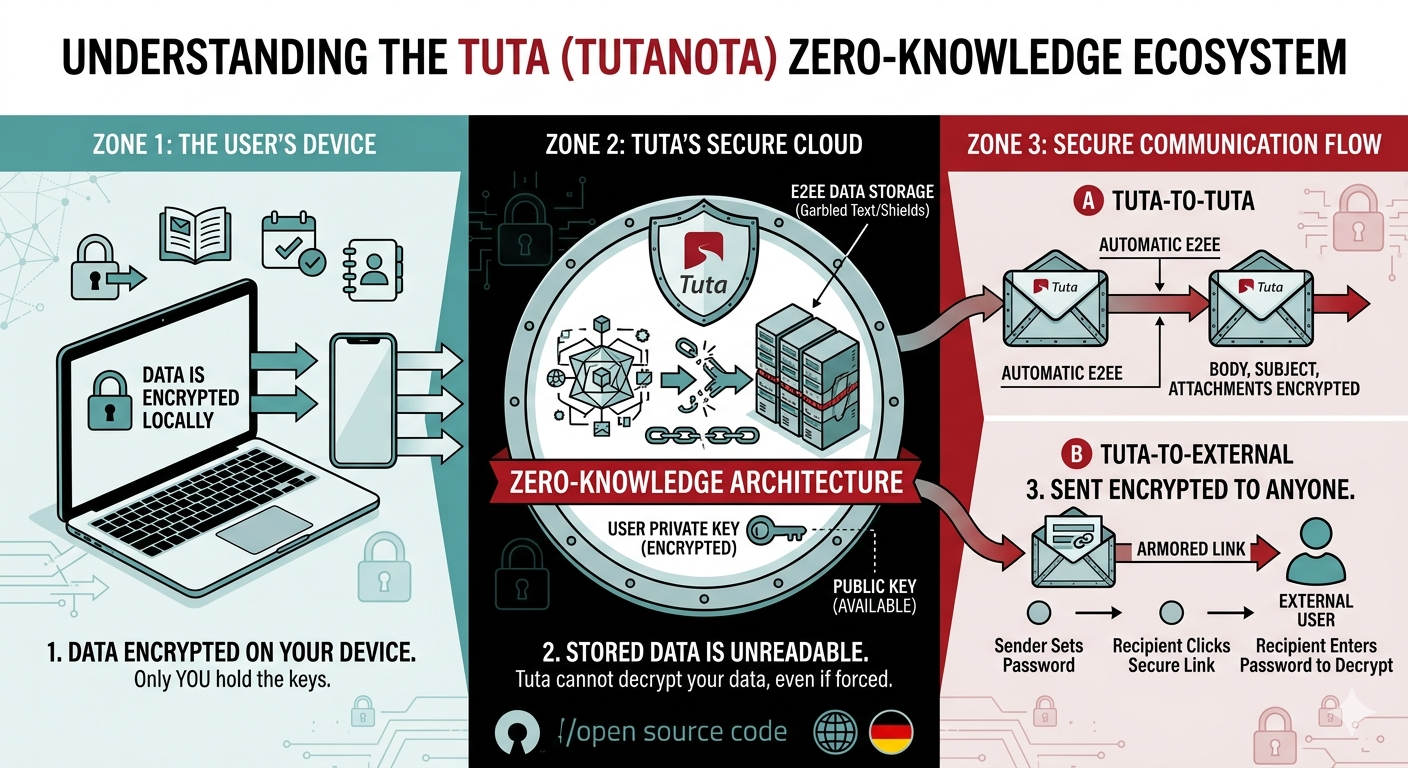
- Tuta-to-Tuta: Every email sent between Tuta users is automatically encrypted end-to-end. The subject line, the full body, and all attachments are encrypted locally on the sender’s device and can only be decrypted by the recipient. The Tuta servers never possess the keys to read this data.
- Tuta-to-External: Tuta also allows users to send secure emails to anyone, regardless of their email provider. The sender simply defines a shared password when composing the email. The recipient receives an email containing a link to a secure interface where they enter the password to decrypt the message and reply securely. This system ensures that even temporary communication can remain private.
B. The World’s First Encrypted Calendar
Tuta developed the world’s first end-to-end encrypted calendar. While other providers might encrypt the data on their servers, Tuta’s “zero-knowledge” architecture means the server cannot even see the notification times of your events. Tuta pushes encrypted notifications directly to your local clients (mobile or desktop) which are decrypted locally. This prevents the provider from mapping your schedule or knowing when you have appointments.
C. Encrypted Contacts and Address Book
Similar to the email and calendar, your entire address book in Tuta is encrypted. Contact details—names, numbers, notes, and relationships—are secured, meaning that your network of contacts is private, even from Tuta itself.
3. The Pillars of Tuta’s Security Model
Tuta’s effectiveness is built upon three pillars: Zero-Knowledge Architecture, Open Source, and German Jurisdiction.
Pillar 1: Zero-Knowledge Architecture
The crucial distinction of Tuta is its “zero-knowledge” approach. Most cloud providers operate a system where they manage the encryption keys, meaning they can legally be compelled to access and provide user data. Tuta flips this model.
When you create a Tuta account, your private key is generated on your device and is itself encrypted by your login password. The Tuta server stores the encrypted private key and the public key, but it never sees your password or the plaintext private key. Therefore, even if Tuta’s servers were physically seized, hacked, or subject to a gag order, they contain only cryptographic garble that they cannot decipher.
Pillar 2: The Importance of Open Source
Tuta is open source. Its client code (for web, desktop, and mobile) is publicly available on GitHub for scrutiny by security experts and the community. This transparency is vital for trust. Users do not need to rely on the company’s marketing claims; they can verify that the encryption is implemented correctly and that no “backdoors” exist. If the company were to introduce a weakness, it would be quickly identified by the community.
Pillar 3: Hosted in Germany under strict GDPR
Tuta hosts all its data in its own highly secure data centers located in Germany. Germany has some of the strictest data protection laws in the world (the Federal Data Protection Act), aligned with the EU’s General Data Protection Regulation (GDPR). German law does not permit “gag orders” that could force Tuta to implement backdoors or hand over encryption keys secretly.
4. Addressing Future Threats: Post-Quantum Cryptography
Mainstream encryption protocols, such as RSA, currently protect data based on mathematical problems that are too complex for classic computers to solve. However, the advent of powerful quantum computers poses a theoretical threat; they could potentially crack these codes easily.
Tuta is a pioneer in preparing for this scenario. It has introduced TutaCrypt, a hybrid encryption protocol that combines traditional algorithms with quantum-safe, lattice-based cryptography (using CRYSTALS-Kyber). By implementing this quantum-resistant layer now, Tuta ensures that emails sent today cannot be captured and decrypted by adversaries years from now when quantum computing becomes mature.
5. Conclusion: Why Choose Tuta?
Tuta offers a clear, uncompromising choice for users who value digital sovereignty. By integrating end-to-end encryption into every aspect of email, calendar, and contacts, and committing to a transparent, open-source model under strong German privacy laws, Tuta provides a true sanctuary in the digital world. Whether for individuals protecting personal information or businesses safeguarding proprietary data, Tuta stands as a testament that privacy is achievable without sacrificing the convenience of modern cloud services.
Visual Representation: The Tuta (Tutanota) Zero-Knowledge Ecosystem
Below is a detailed visual concept illustrating the data flow and security architecture of the Tuta platform, highlighting its core “zero-knowledge” principle.
Source:Tuta (email) – Wikipedia