
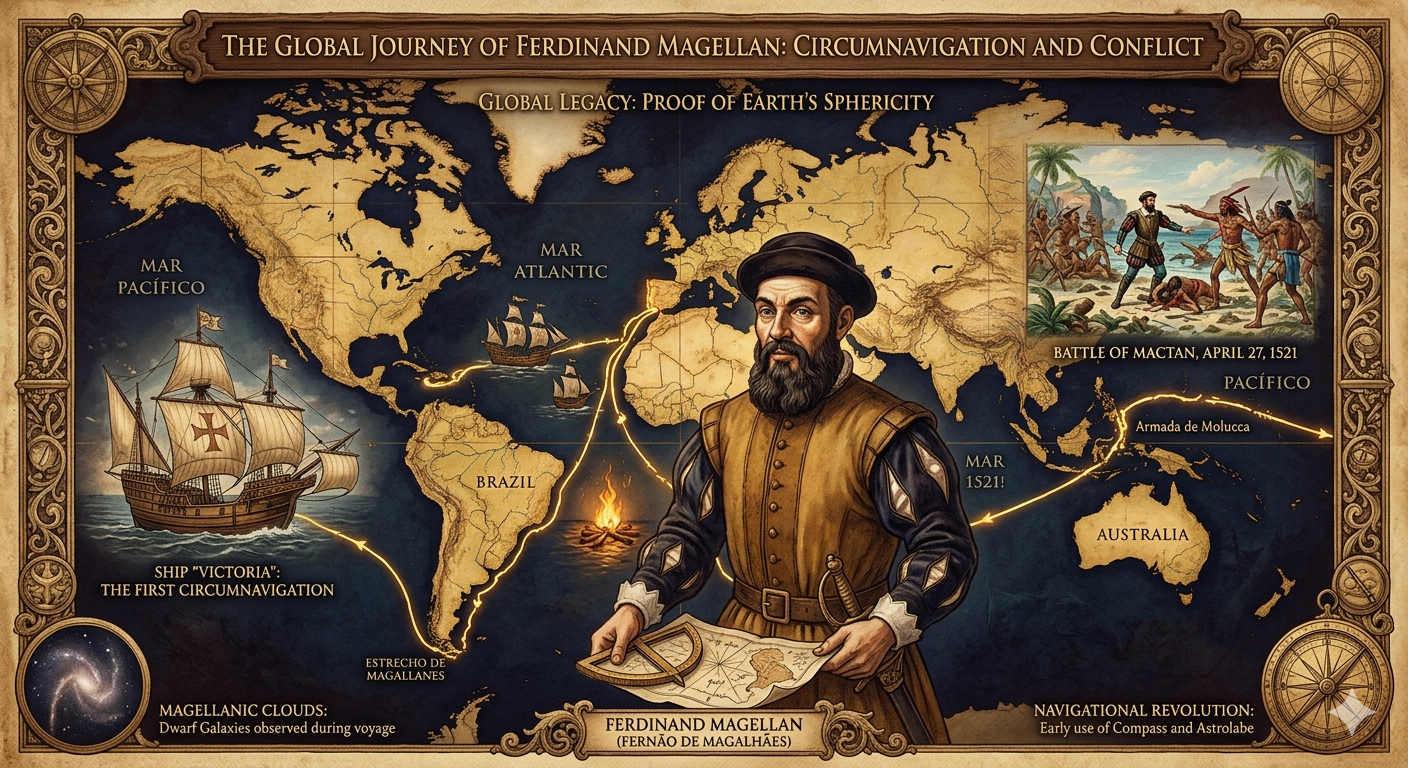
The term Magellan carries immense weight across global history, science, space exploration, and healthcare. While it primarily honors Ferdinand Magellan, the visionary Portuguese explorer who spearheaded the first expedition to circumnavigate the Earth, the name has been adopted by groundbreaking technologies, space missions, and corporate enterprises that embody the spirit of discovery and navigation.
1. Ferdinand Magellan: The Man Who United the World
To understand the modern use of the name, one must look to the man who first made it immortal. Born Fernão de Magalhães around 1480, Magellan was a seasoned Portuguese navigator who faced rejection from his own king when proposing a bold new trade route. Refusing to abandon his vision, he renounced his nationality and convinced King Charles I of Spain to fund a daring voyage: reaching the lucrative Spice Islands (the Moluccas in modern Indonesia) by sailing west, rather than east around Africa.
The Great Westward Expedition
In September 1519, Magellan set sail with five ships (the Trinidad, San Antonio, Concepción, Victoria, and Santiago) and a crew of roughly 270 men. The journey was plagued by catastrophe, including freezing Arctic winds, a violent mutiny in Patagonia, and the loss of two ships before they even found a passage to the west.
In October 1520, Magellan finally discovered the narrow, treacherous maze of fjords at the southern tip of South America—now mapped forever as the Strait of Magellan. Upon emerging into the open ocean on the other side, he found the waters remarkably calm and christened it the Mar Pacífico (the Pacific Ocean).
Tragedy and Triumph
Magellan severely underestimated the scale of the Pacific. The crew spent over three agonizing months crossing the open ocean without fresh food or water, reduced to eating sawdust and leather rigging to survive. Though they eventually made landfall in Guam and the Philippines, Magellan would never see Spain again. He was killed on April 27, 1521, in the Battle of Mactan, after intervening in a local political conflict against the warrior chief Lapulapu.
Following his death, Juan Sebastián Elcano took command of the sole surviving ship, the Victoria. Sailing west across the Indian Ocean and around Africa, Elcano brought the battered vessel back to Spain in September 1522. Only 18 of the original crew returned, but they had accomplished the impossible: the first recorded circumnavigation of the globe.
2. Cosmic Exploration: The Magellan Spacecraft
The spirit of charting the unknown seamlessly transitioned from Earth’s oceans to the vastness of outer space. Launched by NASA in May 1989 aboard the Space Shuttle Atlantis, the Magellan Spacecraft (also known as the Venus Radar Mapper) was a robotic space probe sent to study our sister planet, Venus.
                  =================================
                  NASA'S MAGELLAN MISSION TO VENUS
                  =================================
                  * Launch Date: May 4, 1989
                  * Arrival at Venus: August 10, 1990
                  * Primary Instrument: Synthetic Aperture Radar (SAR)
                  * Percentage of Planet Mapped: 98%
                  =================================
Venus is perpetually shrouded in a thick, toxic atmosphere of carbon dioxide and sulfuric acid clouds, making its surface completely invisible to conventional optical cameras. Named after the explorer who mapped Earth’s most hidden straits, the Magellan probe used advanced Synthetic Aperture Radar (SAR) to peer through the dense cloud cover.
Over four years in orbit, the spacecraft mapped a staggering 98% of the Venusian surface with unprecedented clarity. It revealed a dynamic, hostile world dominated by massive volcanic plains, towering shields, immense lava channels, and remarkably few impact craters—suggesting the planet’s surface is geologically young. The mission concluded in October 1994 when scientists intentionally commanded the craft to plunge into the Venusian atmosphere, gathering atmospheric data before burning up.
3. The Giants of Astronomy: The Magellanic Clouds and GMT
In astronomy, Magellan’s name is also inextricably linked to the cosmos visible from Earth’s Southern Hemisphere.
The Magellanic Clouds
During the historic 1519 voyage, Magellan’s crew documented two glowing, irregular patchworks of stars in the night sky that were completely invisible to European observers. Known today as the Large Magellanic Cloud (LMC) and the Small Magellanic Cloud (SMC), these are actually satellite dwarf galaxies orbiting our own Milky Way. Located roughly 160,000 and 200,000 light-years away respectively, they serve as crucial laboratories for modern astronomers studying star formation and galactic evolution.
The Giant Magellan Telescope (GMT)
Honoring this celestial connection, the next generation of astronomical infrastructure bears the explorer’s name. Currently under construction at the Las Campanas Observatory in Chile’s Atacama Desert, the Giant Magellan Telescope is set to be one of the world’s most powerful ground-based telescopes. Using an array of seven massive monolithic mirrors, the GMT will produce images ten times sharper than those of the Hubble Space Telescope, allowing humanity to look back to the dawn of the universe and probe the atmospheres of distant exoplanets for signs of life.
4. Modern Horizons: Corporate and Technological Navigation
Beyond history and science, “Magellan” has become a premier brand name signifying guidance, navigation, and systemic organization.
- Magellan GPS (MiTAC Digital Corporation): In the consumer tech boom of the 1990s and 2000s, Magellan became a household name as a pioneer in portable GPS navigation systems, guiding drivers, hikers, and sailors across the globe using satellite arrays.
- Magellan Health: In corporate infrastructure, Magellan Health stands as a major American healthcare management company, focusing primarily on behavioral health, pharmacy benefits, and complex care management—effectively helping patients “navigate” the complex landscape of modern medicine.
Summary of Impact
Whether looking back at a wooden caravel navigating the stormy tip of South America, looking up at dwarf galaxies in the night sky, or examining radar imagery from a planetary probe, the word Magellan remains humanity’s ultimate synonym for exploration. It represents the unyielding drive to chart what is hidden, cross what seems impassable, and expand the horizons of human knowledge.
Also Read: The Evolution of Modern Tech and Automotive Icons
Source: Magellan expedition – Wikipedia