
Deep within the labyrinthine mangroves of the Sundarbans, where the land bleeds into the sea and the air hums with a primeval energy, lives the story of the naavpal. A term whispered by the boatmen and sung by the women who mend the nets, naavpal is more than a tradition; it is the vital, silent pulse that keeps the delta beating.
This concept, though specific to this unique ecosystem, speaks to a universal truth: resilience is often woven not from grand gestures, but from countless quiet acts of community, endurance, and adaptation.
The Crucible of the Delta
The Sundarbans, spread across India and Bangladesh, is a wilderness defined by flux. Here, one must navigate tides that erase paths, storms that rewrite the map, and an atmosphere that constantly challenges survival. The delta’s residents—the Munda, Santhal, and many Bengali communities—are descendants of those who, for generations, dared to settle this complex, dynamic landscape.
They did not conquer it; they forged a relationship with it. They learned to read the sky’s color before a cyclone, to understand the migration patterns of the mudskippers, and crucially, to support each other through the relentless cycles of hardship.
Deciphering Naavpal
The word itself, rooted in local dialect, translates directly as “boat-strength” or “vessel-force.” However, this literal definition barely scratches the surface of its true meaning. In practice, naavpal describes a specific, organic form of collective action. It is the spontaneous, unprompted rallying of neighbors and kin when the environment demands extraordinary cooperation to save a vital shared resource.
The most critical and recognizable iteration of naavpal occurs during disasters—particularly when a tidal surge (a “ban”) threatens the vital earthen embankments (bandh) that protect agricultural land from saltwater intrusion. In these desperate moments, standard emergency relief is often absent, delayed by the remote and treacherous geography. Naavpal is the community’s answer.
The Ritual of Response
Imagine a typical crisis scenario: a cyclonic storm approaches. The sky turns a bruised, copper hue, and the wind, previously a whisper, begins to shriek. The delta braces itself. For the fishing and agricultural communities, this is not just weather; it is a primal threat to their existence.
The moment the bandh shows signs of failing, the ritual of naavpal activates. There is no central alarm, no official decree. The signal is organic—the sound of a sacred conch shell blowing across the water, the rapid beat of a traditional drum, or simply shouts carried by the wind.
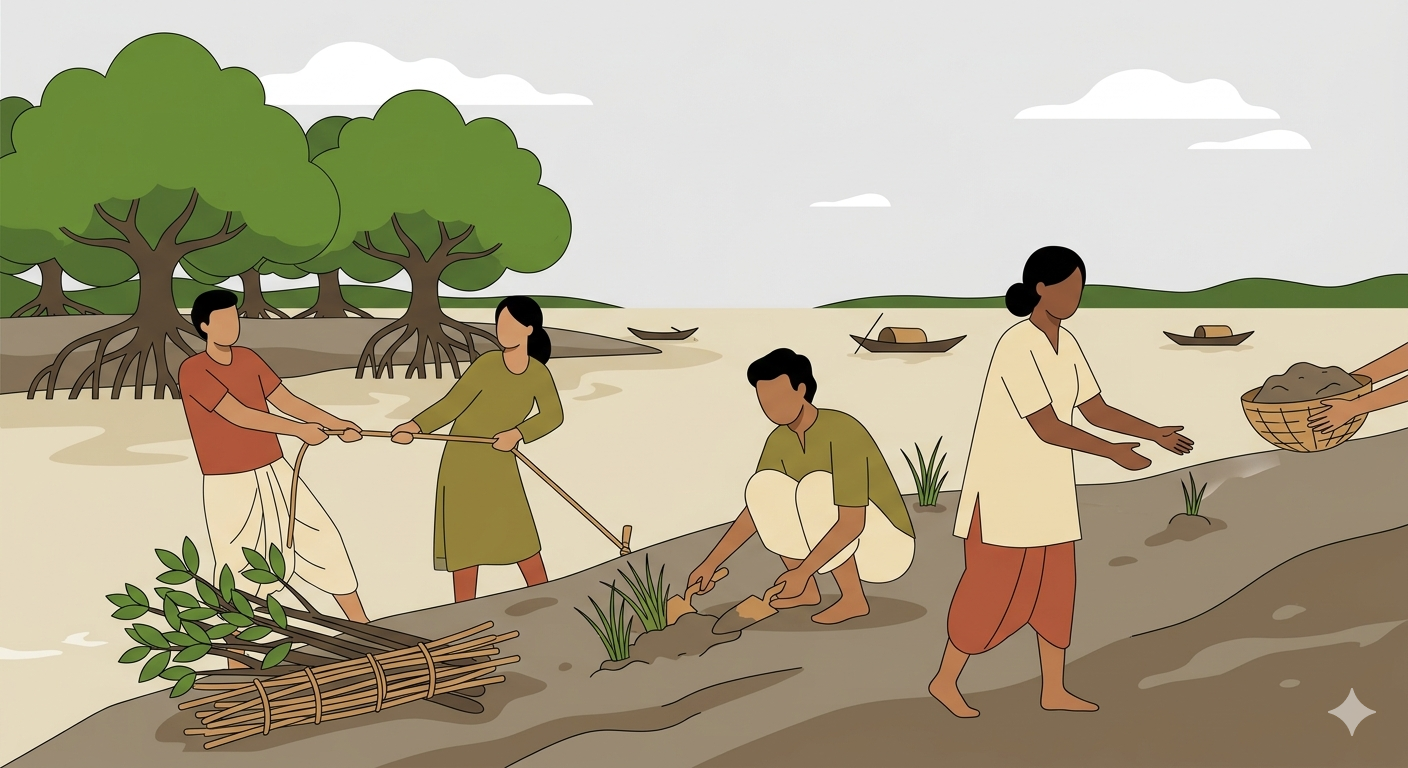
This is the moment captured so vibrantly in our visualization. We see the collective mobilization. When the naavpal call sounds, age, gender, and social standing recede. Women who have finished their domestic tasks, men returning from the fishing boats, children, and the elderly all move towards the breach.
They gather in a human chain along the muddy, fragile bank. In the visualization, the action is focused on reinforcing a breach. Dozens of hands, slippery with mud, work in synchronization. They form a bucket brigade of endurance, passing heavy baskets of clay and silt gathered from the adjacent fields. This is naavpal: the physical manifestation of communal strength applied directly to the wound inflicted by nature.
Other groups work to stabilize the existing slope, laying down mats woven from local grasses and driving bamboo stakes deep into the mud to anchor the new material. Every action is precise, practiced over centuries.
The Ecology of Strength
Why is naavpal so effective? Its power lies in its deep integration with the local ecology. The materials used to repair the bandh are not imported concrete or steel; they are the same materials the delta is made of—silt, mud, and local wood. This creates a fix that is flexible and resilient, able to settle and adapt as the landscape shifts.
Naavpal recognizes that the community is not separate from the ecosystem but is a crucial part of it. The survival of the bandh is essential for the fish populations to thrive, which in turn supports the fishing boats (the actual ‘naav’). Thus, the concept of “boat-strength” is recursive—the community strengthens the land, and the land, through its resources, strengthens the community and their vital vessels.
Naavpal as Intangible Heritage
The significance of naavpal transcends practical utility. It serves as a powerful repository of local knowledge and values.
Collective Resilience: In a modern world where individual triumph is often celebrated, naavpal emphasizes the strength of the collective. It teaches that single-handed efforts are fragile, but mutual interdependence is robust.
Adaptation and Agency: It is an exercise in agency. Instead of waiting for external aid, the community takes its survival into its own hands. They are not passive victims of the environment; they are active managers, constantly adapting.
Environmental Stewardship: Implicit in naavpal is a profound respect for the ecosystem. The community understands the limit of their intervention; they reinforce the structure, but they do not attempt to completely dominate the delta’s logic.
Challenges and the Modern Current
Despite its enduring strength, naavpal faces modern challenges. The increasing frequency and intensity of cyclones due to climate change are pushing these traditional responses to their limits. Furthermore, the migration of younger generations to urban areas disrupts the crucial transmission of local knowledge. The intricate understanding of how, where, and when to apply naavpal is a wisdom held largely by the elders.
To preserve naavpal, it must be recognized not as an outdated tradition but as a vital survival mechanism and an irreplaceable piece of cultural heritage.
Conclusion
The story of the Sundarbans is often told as one of conflict—between tiger and man, or between raging water and fragile land. But look deeper, past the immediate struggle, and another narrative emerges: one of silent, enduring strength. Naavpal is that narrative. It is the evidence that in the most challenging landscapes, human resilience is defined not by how we isolate ourselves, but by how we come together. It is the knowledge that when the tide rises, we find our strongest anchor in each other.
Also Read: RoboForm: Your Digital Assistant for Secure Password Management and Online Convenience
Source: Your Ultimate Guide to Fixing Common Navpal Map Update Issues – NAVPAL