
TomTom (TOM2) is a leading independent location technology specialist, shaped by a 30-year legacy of innovation. While many first encountered the name on a portable navigation device (PND), commonly known as a “satnav,” the TomTom of today is a powerhouse that provides critical digital map data, navigation software, and real-time traffic services to an entirely different, mostly business, customer base. Its primary goal is to help vehicles, people, and goods move safely, efficiently, and predictably around the globe. Headquartered in Amsterdam, TomTom’s technologies are fundamental components in automotive in-dash systems, complex fleet management software, and the spatial services powering dozens of global tech platforms.
The Three Core Pillars of TomTom Content
TomTom’s entire business model is built around creating and managing complex location data. This “content” can be categorized into three primary, interconnected pillars: Maps, Software, and Services.
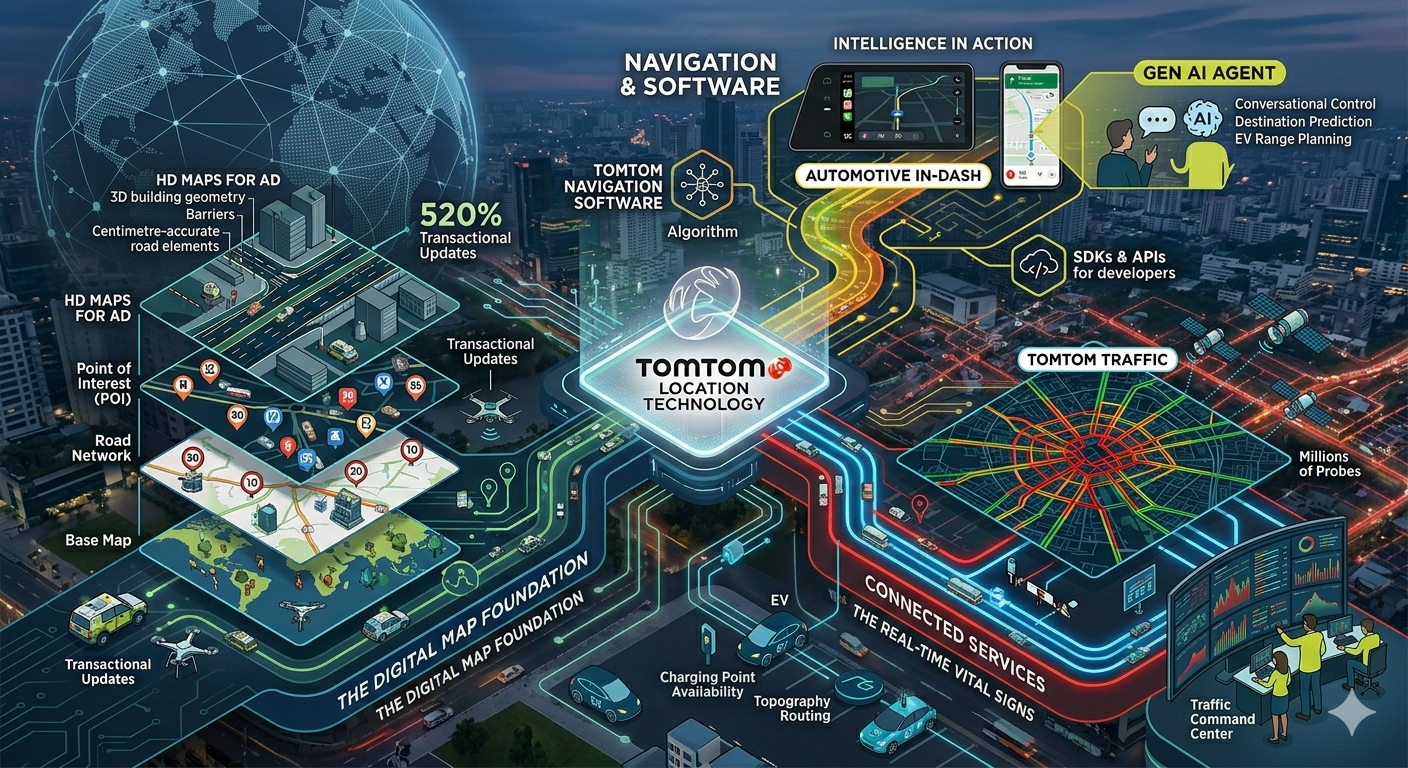
- Digital Maps: The Multi-Layered Foundation TomTom does not just draw lines on a screen. It builds and maintains a massive, multi-faceted digital representation of the physical world. This goes far beyond standard turn-by-turn navigation data. TomTom’s map content is transactional, meaning it is constantly updated to reflect a world that changes every second. It includes:
- High-Definition (HD) Maps: Crucial for the future of Autonomous Driving (AD), these maps provide centimetre-level accuracy and multiple layers of environmental detail, such as lane geometry, road curbs, barriers, and even traffic light placements. This allows an autonomous vehicle to position itself precisely within its environment, beyond what sensors alone can achieve.
- Advanced Driver Assistance Systems (ADAS) Maps: These maps enhance the safety and comfort of driven vehicles by providing predictive road information, like upcoming slope gradient, road curvature, and speed limits, allowing vehicles to optimize fuel efficiency and adjust adaptive cruise control systems before the sensors can see.
- Orbis Maps: Launched in 2022, TomTom’s Orbis is an open, flexible map platform designed to set new standards in mapmaking by pooling map content from users and partners worldwide.
- Navigation and Software: The Intelligence in Action The raw map data must be processed and applied to be useful. TomTom creates the software and algorithms that transform points of interest and road networks into intelligent route planning and guidance.
- TomTom Navigation Software: This is the logic embedded in dashboards by automotive partners (like Volkswagen, Renault, and Stellantis). It handles everything from global geocoding (turning an address into coordinates) to calculating the fastest route. It is modular, allowing automakers to customize the user interface while trusting the underlying technology.
- Applications: TomTom still provides software directly to consumers through its mobile applications, like TomTom GO Navigation and the community-driven TomTom AmiGO, offering real-time guidance, speed camera alerts, and traffic avoidance.
- AI and Generative Technology: TomTom is a pioneer in integrating AI into the vehicle. Their recent work involves using large language models (LLM) for a more interactive and context-aware driving experience. The TomTom AI Agent, for example, allows conversational control over in-vehicle technology, listening, learning, and responding to driver needs.
- Connected Services: The Real-Time Vital Signs A digital map is only as good as its most recent update. TomTom’s connected services provide the vital real-time information that makes a static map dynamic.
- TomTom Traffic: This is perhaps the company’s most well-known service. It creates a complete, precise live traffic view, processing data from hundreds of millions of probes—from anonymous mobile phone users to connected vehicles and traditional sources like road sensors. This content is used not only for real-time routing in vehicles but also by governments and traffic authorities via the TomTom Traffic Command Center to manage congestion, plan infrastructure, and improve city mobility.
- EV Services: For electric vehicle drivers, TomTom provides specialized content, including the accurate location of charging points, their availability, and advanced routing that accounts for vehicle range, topography, and real-time consumption, ensuring a worry-free journey.
How TomTom Operates: Two Core Markets
TomTom structures its operations to deliver this content through two main market segments:
- Location Technology (B2B): This segment combines its Automotive and Enterprise businesses and now accounts for the vast majority of its revenue.
- Automotive: TomTom sells location technology components to carmakers. Their navigation software is integrated into vehicle platforms to provide current map data, online routing, and guidance information, enabling advanced driver assistance and future highly automated driving features.
- Enterprise: This includes licensing its data and services to technology giants and other businesses. This is where TomTom’s maps, search APIs, traffic information, and routing algorithms empower the spatial functions of other platforms. For example, Uber has used TomTom’s maps and traffic data, and Huawei integrated TomTom services as its mapping provider.
- Consumer: This is the legacy segment, which sells portable navigation devices (PNDs) and subscription apps. While PND usage has declined due to smartphones, TomTom continues to innovate with specific models for trucks, campers, and motorcycles, and maintains a user base through its premium navigation apps.
In Conclusion
TomTom is far more than a hardware manufacturer; it is a vital, invisible layer of the digital world. It is a mapmaker, a traffic authority, a software developer, and an AI innovator. By creating and managing a complex ecosystem of dynamic, real-time, and high-definition location content, TomTom has transitioned from a popular satnav provider into the essential technological skeleton that powers the current and future of global mobility. Its technology doesn’t just show you where to go; it understands how the world is moving and optimizes the journey for everything and everyone.
Also Read: Understanding the Migration: Verizon, AOL, and the End of the Verizon.net Era – My Tech Blaze