
The story begins in 1856 when William Rand, a native of Boston, opened a small printing shop in Chicago, Illinois. Two years later, a young Irish immigrant and printer named Andrew McNally joined the shop. By 1868, the duo formally established Rand McNally & Co.
The timing of their partnership was impeccable. Chicago was rapidly transforming into the definitive railroad hub of a growing nation. Recognizing a massive commercial opportunity, Rand and McNally specialized in printing tickets, timetables, and promotional guides for the booming railroad industry.
When the Great Chicago Fire of 1871 devastated the city and destroyed their printing presses, the founders didn’t give up. They famously rented a couple of printing machines in a nearby town, shipped them into the smoking ruins of Chicago, and resumed operations almost immediately.
By 1872, the company introduced its first map in the Western Railway Guide. This marked a massive shift in their business model, steering them away from simple commercial printing and toward the specialized art and science of cartography (mapmaking).
The Wax-Engraving Revolution
During the late 19th century, creating detailed maps was a slow, expensive process that relied heavily on copperplate engraving. Rand McNally revolutionized the industry by adopting and perfecting wax engraving.
This process allowed mapmakers to trace designs onto a thin layer of wax coating a copper plate. It made printing much faster, drastically lowered production costs, and allowed for easy text updates. Suddenly, maps were no longer luxury items reserved for scholars or wealthy merchants. They became affordable, everyday tools for the general public, students, and businesses.
By 1880, the company launched its first educational line, producing high-quality school maps, globes, and geography textbooks. Generations of students grew up looking at massive, pull-down Rand McNally maps hanging at the front of their classrooms.
Mapping the Age of the Automobile
As the 20th century dawned, a new invention completely reshaped American life: the automobile. Early drivers faced a massive challenge because there were virtually no standardized road signs, highway numbers, or reliable maps for cars.
Rand McNally stepped in to fill this void:
- The Photo-Auto Guide (1907): Rather than traditional illustrations, this guide used actual photographs of intersections with hand-drawn arrows telling drivers where to turn.
- Blazing the Trail: Before the federal government established the numbered U.S. Highway System in 1926, Rand McNally employees physically drove across the country, painting colored bands on telephone poles to mark routes and naming trails (like the Lincoln Highway).
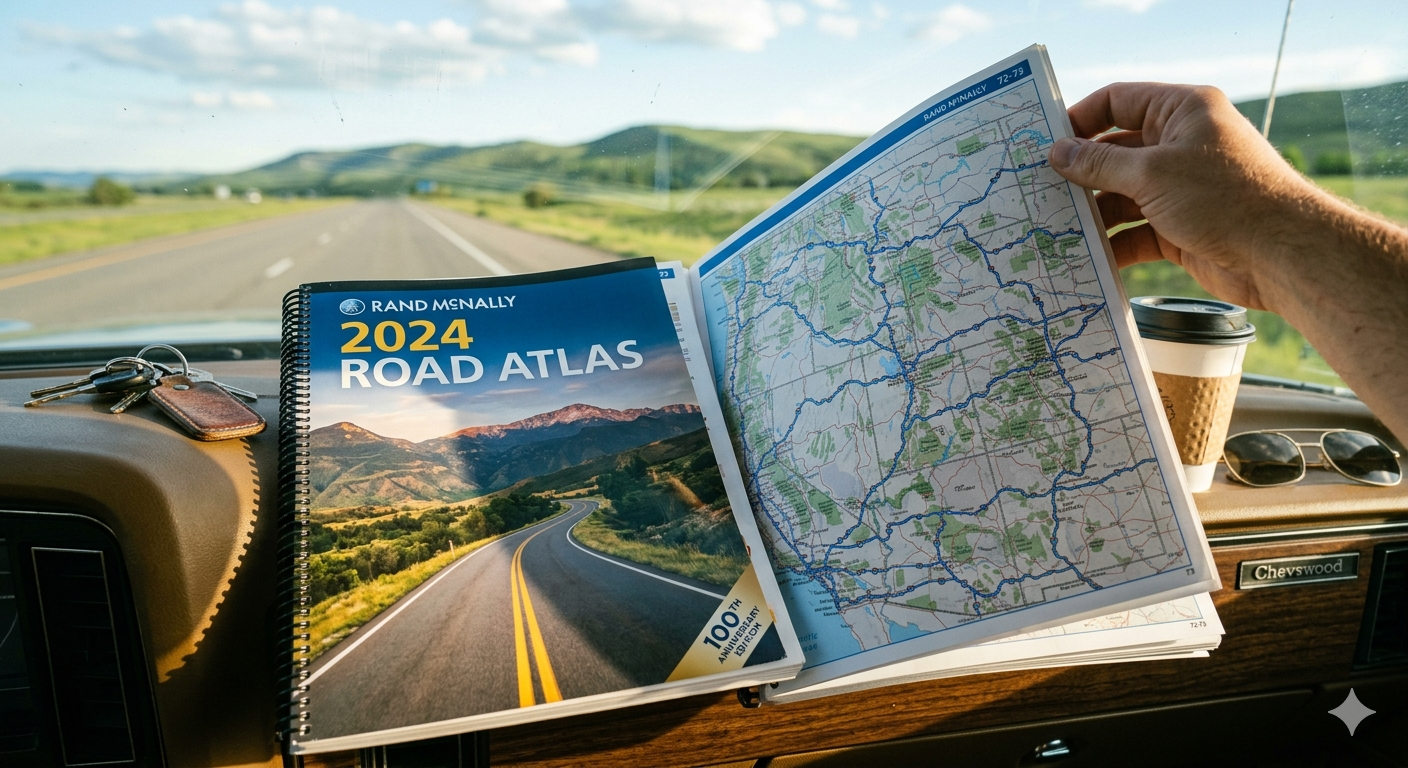
- The Birth of the Road Atlas (1924): The company published its very first Rand McNally Cosmopolitan Automobile Road Atlas. It featured comprehensive maps of every state, quickly becoming an essential item in every car’s glove compartment.
The Road Atlas became a cultural icon. It symbolized freedom, the classic American road trip, and family vacations to national parks.
The Evolution of the Product Line
Over more than a century and a half, Rand McNally diversified its offerings to match changing consumer lifestyles. Its portfolio grew to include:
| Product Category | Primary Target Audience | Core Purpose |
| The Road Atlas | Casual road trippers & families | Annual highway updates, scenic routes, national park guides |
| Commercial Trucking Atlases | Professional long-haul drivers | Weight limits, low clearance warnings, toll routes |
| Educational Materials | K-12 classrooms & libraries | Globes, atlases, and interactive geography curriculum |
| Digital Fleet Management | Logistics companies & fleets | Electronic Logging Devices (ELDs), routing software |
Pivoting to the Digital Era
The rise of digital technology in the late 1990s and 2000s posed an existential threat to traditional print cartography. With internet mapping services and mobile GPS apps offering real-time traffic updates for free, the market for folded paper maps shrank dramatically.
Rand McNally adapted by pivoting its core expertise into specialized tech sectors. Instead of competing directly with consumer smartphone apps, they focused heavily on the commercial transportation and logistics industry.
They developed advanced, ruggedized dashboard GPS units tailored specifically for commercial truckers. These devices factor in truck dimensions, hazardous material restrictions, and bridge heights—critical data points that standard consumer GPS apps omit. They also expanded into telematics, providing fleet management software to help logistics companies track fuel efficiency, safety metrics, and regulatory compliance.
An Enduring Legacy
While ownership has changed hands several times in recent decades—including its acquisition by private equity firms looking to revitalize its digital products—the brand identity remains deeply rooted in American history.
Even today, in a world dominated by satellite imagery and digital screens, millions of travelers still buy the printed Rand McNally Road Atlas every year. For many, it provides a physical, bird’s-eye view of a journey that small phone screens simply cannot replicate. It stands as a tactile reminder of an era when navigating the world required a little bit of patience, a sense of adventure, and a trusted paper map.
Also Read: Unveiling Intego: A Comprehensive Guide to Cybersecurity for a Digital World – My Tech Blaze
Source: Optimizing Fleet Performance with Rand McNally | Rand McNally