
Since its introduction in the early 2000s, BMW iDrive has redefined how drivers interact with their vehicles. Initially met with skepticism, it has evolved into one of the most sophisticated, intuitive, and feature-rich infotainment systems in the automotive industry.
At its core, iDrive is BMW’s centralized interface for controlling almost every aspect of the vehicle’s secondary functions. This includes entertainment (radio, streaming, media), communication (phone calls, messaging), navigation, vehicle settings (climate control, driving modes, lighting), and increasingly, advanced connectivity features.
The Origin: Complexity Simplified (Eventually)
iDrive debuted in 2001 on the BMW 7 Series (E65). It was a radical concept designed to clean up the dashboard. Instead of having dozens of dedicated buttons and switches for the stereo, AC, and navigation, BMW consolidated most of these functions into a single screen and a large, tactile controller knob located on the center console.
The concept was brilliant, but the initial execution was criticized. Early versions (iDrive 1.0) were often described as non-intuitive, with menus nested too deeply and sluggish performance. BMW, however, was committed.
Evolution and Refinement
Over subsequent generations, BMW dramatically improved the system by:
- Iterative UI Design: Making the menus flatter and more logical.
- Adding Short-cut Buttons: Placing physical buttons (CD, Radio, Tel, Nav) around the controller wheel allowed users to jump directly to primary functions without navigating menus.
- Hardware Upgrades: Faster processors and better screens significantly reduced latency.
- Touch Integration: While the controller remained, BMW eventually integrated touchscreens, giving drivers multiple ways to interact.
How iDrive Works Today (e.g., iDrive 8 and 8.5)
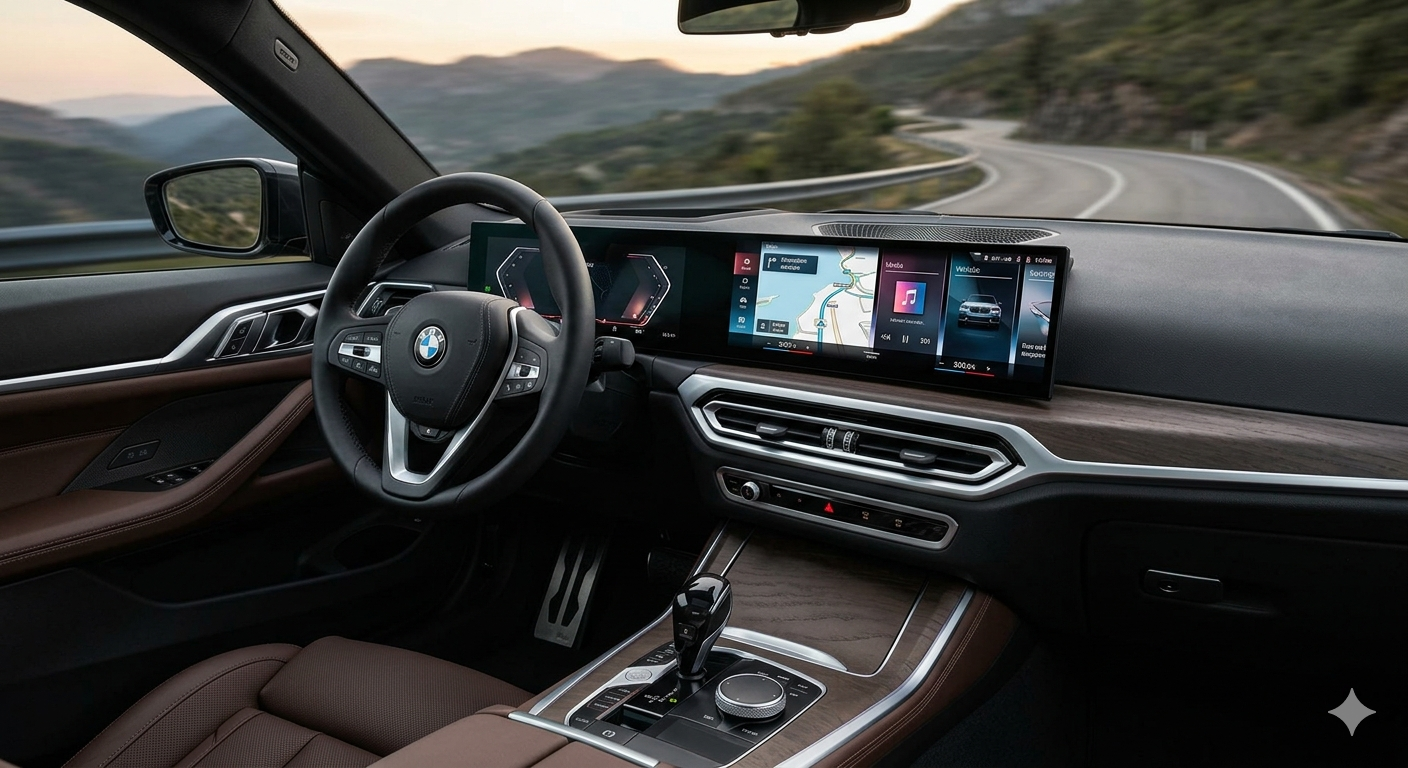
Today’s iDrive (most notably generations 8 and 8.5, and the new Operating System 9) is a hybrid interface that leverages a combination of control methods, often centered around the massive BMW Curved Display. This display seamlessly merges a 12.3-inch information display (the gauge cluster) with a 14.9-inch control display.
The modern iDrive experience is defined by four main control pillars:
- The iDrive Controller: The iconic, rotary knob on the center console persists. It remains highly effective, allowing drivers to navigate menus without taking their eyes off the road, using physical feedback. It also features a touchpad surface (on top of the knob) for writing addresses or numbers with a finger.
- Touchscreen Interface: The central Curved Display offers quick, tablet-like interaction for passengers and drivers who prefer touching the screen.
- Voice Control (BMW Intelligent Personal Assistant): This is one of the system’s biggest breakthroughs. By saying “Hey BMW” (or a customized prompt), drivers can control functions using natural language processing. Commands like “Hey BMW, I’m cold,” “Find me a coffee shop nearby,” or “Navigate to the Munich airport” are easily understood.
- Gesture Control (Optional): This feature uses a 3D sensor in the roof liner to detect hand movements near the screen. Drivers can adjust volume (by spinning a finger), accept or reject calls, or assign custom commands by pointing or waving.
Connectivity and Personalization
Modern iDrive is deeply integrated with online services. Features like wireless Apple CarPlay and Android Auto are standard. BMW ConnectedDrive allows for advanced remote services (like starting the climate control, locking doors, or checking the fuel level via a smartphone app), and real-time traffic information.
The system also heavily prioritizes personalization. Drivers can create personal BMW IDs, storing their unique settings for seat positions, climate, mirror adjustments, and even complex system configurations, all loaded via a key fob or phone profile.
The Image: A Modern iDrive Dashboard
The image below illustrates the interior of a current BMW (an i4 M50), focusing heavily on the Curved Display running the contemporary iDrive interface. Notice the large map visualization and the widgets (media, phone, vehicle status) displayed prominently, all manageable via the central touchscreen or the controller wheel in the foreground.
Part 2: The Ford Mustang: An American Icon
While iDrive focuses on connectivity and interface, the Ford Mustang represents raw, accessible performance, freedom, and quintessential American style. Since 1964, the Mustang has been more than just a car; it is a cultural phenomenon that invented its own segment—the “Pony Car.”
The Launch: A Marketing Masterstroke
The Ford Mustang was officially introduced on April 17, 1964, at the New York World’s Fair. It was an instant, overwhelming success, far exceeding Ford’s optimistic sales projections. Ford marketed the car heavily to a younger demographic, offering sleek styling (long hood, short deck), a base six-cylinder engine, and—most importantly—an extensive and affordable options list.
This allowed buyers to customize their Mustang: they could build an economical commuter, a stylish cruiser, or, by selecting a V8 engine and performance upgrades, a formidable street machine. This strategy democratized performance.
Defining Characteristics of a Mustang
While the specific hardware has evolved dramatically over seven generations, several key attributes remain core to the Mustang identity:
- Pony Car Proportions: A long front hood, a short rear deck (creating the “2+2” coupe profile), and muscular rear haunches.
- The Powerplant (V8): Although EcoBoost (turbo four-cylinder) models are common and potent, the spiritual heart of a Mustang has always been its available V8 engine (specifically, the famed “Coyote” 5.0L V8 in modern iterations). This V8 provides a characteristic, deep rumble that is central to the driving experience.
- Rear-Wheel Drive (RWD): Power is sent to the back wheels, which contributes to the car’s handling dynamics and classic muscle car feel.
- Affordability: The Mustang has consistently offered higher performance-per-dollar ratios than its competitors.
Performance Milestones and Variations
The Mustang’s history is rich with high-performance variants that cemented its legend. Early examples include the Shelby GT350 and GT500 models, built by Carroll Shelby to dominate road courses and drag strips. The Boss 302 and Boss 429 models were created as homologation specials for Trans-Am and NASCAR racing, respectively.
In the 1980s and 90s, the “Fox Body” Mustangs (Generation 3) became legendary for their lightweight, strong V8s (the 5.0 LX and GT), making them ideal platforms for aftermarket modification. Today, Ford continues this tradition with high-output models like the Mach 1 and the exotic, track-focused Shelby GT500.
The Modern Mustang (Generation 7)
The latest 2024+ Mustang (internally known as S650) continues the RWD V8 legacy but integrates highly advanced technology. It retains a classic profile while introducing a revolutionary interior that, ironically, draws comparison to luxury systems like iDrive, featuring massive customizable digital screens (running the Ford Sync 4 interface). Crucially, Ford has maintained the available six-speed manual transmission alongside its advanced 10-speed automatic, preserving the driver connection that defined the car.
The Image: A Classic Mustang Fastback
The second image provided captures the visual essence of the Mustang legend. It depicts a deep, vintage blue 1968 Ford Mustang GT Fastback. This specific body style is perhaps the most celebrated Mustang silhouette, popularized globally by films like Bullitt. It is shown driving powerfully along a coastal highway at sunset, emphasizing themes of freedom and classic performance.
Also Read: Naavpal: The Silent Pulse of the Sundarbans
Source: Multi-sensory user experience: The BMW iDrive then and now